
Before You Buy: 7 Questions to Ask About Commercial Facility Equipment
A lower price can save money. It can also create an expensive problem. Before purchasing commercial restroom or hydration equipment, these seven questions can help you determine what will actually work for your facility.
Buying commercial facility equipment should be simple.
Find a product that meets the specifications. Compare prices. Place the order.
After more than 20 years helping customers select commercial restroom and hydration equipment, we've learned that some of the most important differences between products don't become obvious until after the purchase.
A hand dryer may require electrical changes that weren't included in the original budget. A replacement flush valve may look right but not match the existing fixture. A bottle filling station may introduce filters the maintenance team wasn't expecting. An inexpensive fixture may become difficult to repair because replacement parts are hard to identify or obtain.
The opposite can happen, too. A facility can spend considerably more for features it doesn't actually need.
That's why the better question isn't:
Which product costs less?
It's:
Which product makes the most sense for this facility?
Before approving your next equipment purchase, ask these seven questions.
Question 1
Will It Actually Work With What We Already Have?
This sounds obvious.
It isn't.
One of the easiest purchasing mistakes to make is assuming that a new product will be a straightforward replacement for the old one.
Before comparing prices, confirm the conditions the new equipment will have to work with. Depending on the product, that can mean checking:
- Voltage, amperage and electrical requirements
- Water supply and drain locations
- Existing rough-in dimensions
- Mounting requirements
- Wall or floor construction
- Finished wall thickness
- Recessed versus surface-mounted installation
- Existing fixture or valve compatibility
- Required accessories and controls
- Available clearances
Even products from the same manufacturer aren't necessarily interchangeable.
A $200 Difference Can Disappear Quickly
Suppose Product A costs $200 less than Product B. That's a real savings, if both products install equally well in the existing space.
But if Product A requires a new circuit, plumbing changes, wall repair or additional accessories, the less expensive product can quickly become the more expensive project.
This is one reason we encourage customers to involve the installer before the order is finalized, particularly when replacing existing equipment.
Category Five Tip
Don't compare equipment prices until you understand the installation. Compare installed solutions, not boxes.
Question 2
Is It Built for the Facility We Actually Have?
There is no universally "best" hand dryer, faucet, flush valve, drinking fountain or other commercial fixture.
There is a best fit for the application.
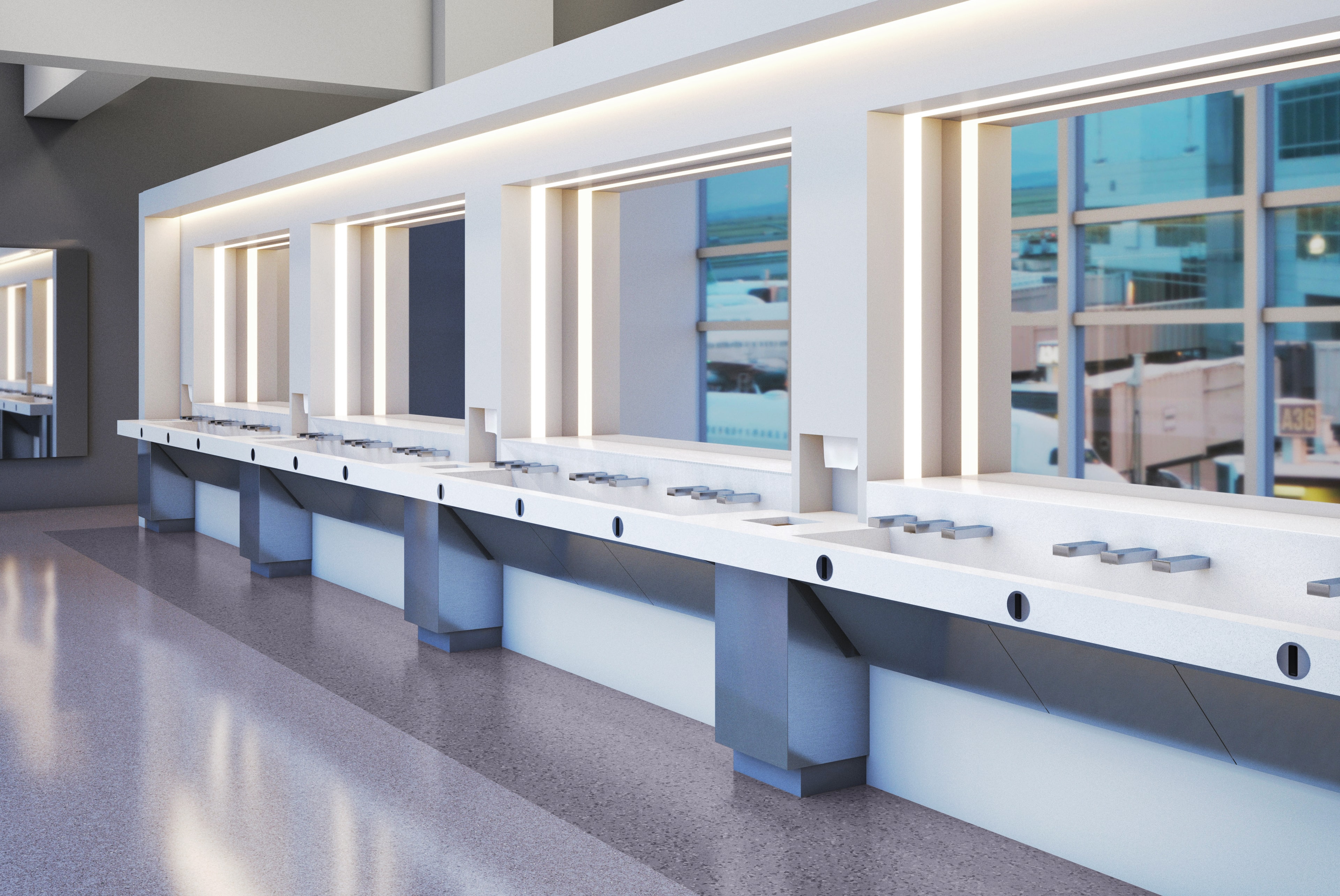
Consider two hand dryers. One will be installed in a small professional office with moderate restroom traffic. The other will be installed in an airport, stadium or busy school where large numbers of people may arrive within a short period.
Both dryers may work exactly as designed. That doesn't mean both are appropriate for both buildings.
The same principle applies throughout a facility. Before selecting equipment, consider:
- Normal daily traffic
- Peak traffic
- Hours of operation
- Age and needs of the user population
- Potential vandalism or misuse
- Indoor versus outdoor exposure
- Noise sensitivity
- Maintenance staffing
- Accessibility requirements
- Appearance expectations
- Project specifications
Don't Buy More Equipment Than You Need
Matching equipment to the application works both ways. A low-traffic office doesn't necessarily need the most powerful, vandal-resistant or feature-rich product available. Paying substantially more for capabilities the building will never use doesn't create additional value.
But equipment designed for moderate use can become a poor investment when placed in an extremely demanding environment.
Key Principle
Question 3
What Will Our Maintenance Team Have to Do After It Is Installed?
This question is surprisingly easy to overlook during purchasing. Someone will eventually have to clean, inspect, adjust and possibly repair whatever you buy.
Before placing the order, find out what that actually involves. Ask:
- Does the product use filters?
- Are batteries required?
- Are cartridges or other consumables required?
- How frequently should those items be inspected or replaced?
- Are service areas easy to reach?
- Can common maintenance be performed without removing the entire unit?
- Are maintenance instructions readily available?
- Can facility staff perform routine service?
- Will some work require a licensed electrician or plumber?
Consider a filtered bottle filling station. Filtration can be an important feature, but it also creates a future responsibility: someone has to monitor and replace the filter. A battery-powered faucet can simplify an installation where electrical service isn't readily available, but those batteries will eventually need attention. A hand dryer with a serviceable air filter introduces a different maintenance requirement than a model without one.
None of these approaches is inherently better. What matters is whether the facility understands the responsibility before buying the equipment.
Ask the People Who Will Maintain It
For larger projects, purchasing decisions shouldn't happen entirely in an office. The person responsible for maintaining the equipment may spot a problem that isn't obvious on a quote or specification sheet.
We've learned that maintainability can be just as important as performance. A great product that is difficult for your facility to maintain can become the wrong product.
Question 4
If Something Breaks Five Years From Now, Can We Fix It?
This is one of the questions we wish more buyers asked. Commercial equipment eventually needs service. The important question isn't whether something will ever require a repair. It's what happens when it does.
Before purchasing, investigate:
- Are replacement parts available separately?
- Does the manufacturer publish useful parts breakdowns or diagrams?
- Is the model number easy to identify?
- Are common service parts stocked through established distribution?
- Is technical documentation available?
- Does the manufacturer have a history of supporting its equipment?
- Can the equipment be repaired without replacing the entire fixture?
A Small Part Shouldn't Always Require a New Fixture
Our teams regularly help customers identify replacement components for commercial equipment that has already been in service for years. Sometimes the difficult part isn't the repair. It's figuring out exactly what is installed.
Model numbers disappear. Labels become damaged. Buildings change maintenance personnel. Paperwork gets lost. Similar-looking products may use completely different internal components.
That's why we recommend documenting equipment when it is installed: manufacturer, model number, serial number, purchase date, installation date, invoice, specification sheet, installation instructions, parts diagram, and warranty documentation. Take a clear photograph of the product label, too. Five or ten years from now, that 30-second task may save somebody hours.
Category Five Tip
Product support is part of the product. A fixture isn't truly inexpensive if a minor failure eventually forces you to replace the entire thing.
Question 5
What Will It Cost Us After We Buy It?
Purchase price is important. It just isn't the last expense. The U.S. Department of Energy uses life-cycle cost analysis when comparing certain building-related investments because alternatives with different initial costs can also have very different operating costs over time. A facility doesn't need a complicated financial model every time it buys a restroom fixture. But the principle is useful.
Look for the Costs That Repeat
How much electricity does the equipment use during operation and standby? For hand dryers, don't look at wattage alone. Drying time, traffic, heat settings and overall performance matter too.
For faucets, flush valves and drinking water equipment, compare published water-use specifications while also confirming compatibility and required performance.
Filters, batteries, cartridges, soap, paper products and other recurring supplies can change the economics of a purchase.
How frequently will someone need to inspect, clean or service the product?
Are replacement parts readily available, and can common failures be repaired economically?
What does it mean operationally when this particular fixture isn't available?
Multiply Small Differences by Scale
A small operating difference on one fixture may not matter much. Multiply it by 20 restrooms, hundreds of fixtures or thousands of uses, and the calculation can change. Five extra minutes of service time doesn't sound significant until that task is repeated across an entire campus for years. That is where total cost of ownership becomes useful, not as an excuse to buy more expensive equipment, but as a way to expose costs that aren't visible on the original quote.
Question 6
What Does the Warranty Actually Cover?
"Five-year warranty" sounds straightforward. It may not be. Before using warranty length to compare products, find out what the warranty actually covers. Look for:
- Covered components
- Different coverage periods for different components
- Required product registration
- Proof-of-purchase requirements
- Labor coverage
- Shipping responsibility
- Installation or removal costs
- Application exclusions
- Conditions that may void coverage
- The process for making a claim
A five-year limited parts warranty and five years of broader coverage aren't necessarily equivalent. The number of years makes a good headline. The terms determine what the warranty is actually worth.
Save the warranty documentation that applies when the equipment is purchased rather than assuming you'll be able to reconstruct everything years later.
Question 7
Will It Work for the People Who Actually Have to Use It?
The final question is the easiest to lose in specifications, quotes and budgets. What's it like to actually use the product?
A fixture can satisfy a long list of technical requirements and still be a poor choice for its environment. Think about what happens on the busiest day the building experiences. Can the equipment handle the traffic? Is it intuitive? Is the noise appropriate for the space? Can it be reached and operated by the people expected to use it? Does its location interfere with circulation? Can a caregiver use the surrounding space when assistance is required? What happens when the fixture is temporarily out of service?
Accessibility Is About More Than the Product
Accessibility deserves particular attention because it can't always be determined by looking at an individual fixture. The 2010 ADA Standards contain requirements involving clear floor space, reach ranges, operable parts and protrusion into circulation paths, among many other provisions. That means the way a product is installed and its relationship to the surrounding room can matter just as much as the product itself.
Adult changing stations are a good example. Choosing between a fixed-height table and a powered height-adjustable station isn't simply a matter of comparing two prices. The usable surface, transfer method, room layout, wall or floor construction, caregiver access, mobility equipment, electrical requirements and project specifications may all affect the decision.
A product doesn't become accessible merely because someone described it as "ADA compliant." The complete installation has to work.
Applicable federal, state and local requirements and the authority having jurisdiction should always be considered for the specific project.
The Question We Ask Instead of "Which One Is Cheapest?"
After more than two decades working with commercial restroom and hydration equipment, we've found that a better purchasing question is:
If we install this product here, for these users, with this maintenance team, will we still be happy with the decision years from now?
That question changes the conversation. It doesn't automatically lead to the premium product. Sometimes the lower-priced option is exactly what we'd choose.
If the facility has moderate traffic, the installation is straightforward, parts are available, maintenance is simple and the additional features of a more expensive model won't provide meaningful value, spending more doesn't make the purchase smarter.
Other times, paying more upfront solves a real problem: greater durability, better performance during peak traffic, easier maintenance, readily available parts, useful adjustability or better compatibility with the existing installation.
Value comes from matching the equipment to the job, not from automatically moving up or down the price sheet.
The 5-Minute Pre-Purchase Check
Before approving an order for commercial facility equipment, stop and answer these questions. If you can't confidently answer one of them, that's worth resolving before the equipment arrives.
| Question | Confirm Before Ordering |
|---|---|
| Installation | Does it match the existing electrical, plumbing, rough-in, mounting and space conditions? |
| Application | Is it appropriate for our normal and peak traffic, environment and users? |
| Maintenance | Who will maintain it, and what recurring work or consumables will it require? |
| Repairability | Are parts, diagrams and technical support likely to be available when we need them? |
| Operating Cost | What energy, water, consumable and maintenance costs continue after purchase? |
| Warranty | What is actually covered, and what isn't? |
| User Experience | Will the complete installation work well for the people using and servicing it? |
One More Thing: Document What You Bought
There's one final step that has almost nothing to do with selecting equipment and can make life much easier later. Create an equipment record.
For larger facilities, this can be a spreadsheet, maintenance system or asset-management platform. For a smaller building, even a well-organized digital folder is better than nothing.
Record the manufacturer, model, serial number, installation location, purchase date, warranty information and replacement-part documentation. Take pictures. Save the manuals. Save the parts diagrams.
Years from now, the person trying to repair that equipment may not be the person who bought it. Give them a head start.
Frequently Asked Questions
Buying Smarter Doesn't Mean Spending More
It means knowing what you're paying for.
A good commercial equipment purchase fits the building, performs under the expected traffic, can be maintained by the people responsible for it, remains repairable, meets the needs of its users and doesn't create surprises during installation.
Sometimes that will be the least expensive option. Sometimes it won't. The objective isn't to buy cheap equipment or expensive equipment. It's to buy the right equipment once.
Category Five Technologies has spent more than 20 years helping facility managers, contractors, architects, engineers and organizations evaluate commercial restroom and hydration solutions. Through ProDryers and ProDrinkingFountains, our team works with commercial equipment every day, from initial product selection to replacement parts and long-term support.
If you're comparing products and aren't sure which option fits your facility, talk to our team before you order. Sometimes the most valuable thing we can tell you is that you don't need to spend more.
Tahnee Talley
Category Five Technologies
Tahnee works with customers and commercial facility products as part of the Category Five Technologies team. Her experience includes helping customers navigate product information, replacement parts, maintenance questions and equipment selection across commercial restroom and facility applications.